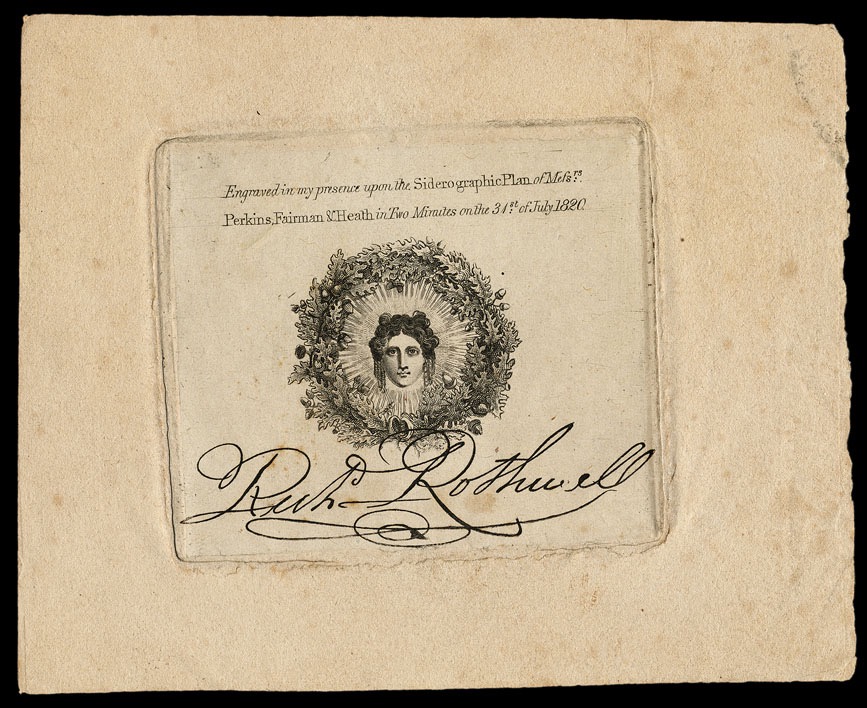
A very early (1820) proof of an engraving produced by the then-new Perkins process of siderography, using a transfer press. This process was subsequently used for most engraving work, including postage stamps, up to the present day. In a nutshell, a design was engraved into a soft steel die; that die was hardened; a soft steel "transfer roll" was rolled over the hardened die under great pressure, picking up the design in reverse; the transfer roll was hardened; and the design was then rolled in the correct position on a plate (in the case of stamps, once at each position on the plate); the plate was hardened and used to print.
(Collection of Joe Freedman)